Monday, October 31, 2016

Michel Aoun Elected President

Free Patriotic Movement leader Michel Aoun, known as the Générale by his friend and (countless) enemies alike, has been elected President of the Republic of Lebanon in an hour long voting procedure that included votes for the likes of "Zorba the Greek" and pop star Myriam Klink.


Mr Aoun's long-time rival, Marada Movement chief Sleiman Franjieh, did not receive a single vote as parliament casted its vote on the future of Lebanon, ending the two and a half year long presidential void that, given the critical role of the country's president both in the legislative process and in facilitating communication and compromise between Lebanon's estranged political faction.

The election of Michel Aoun is the result of a long and stifling process of relucting national dialogue which led to a complete reshuffle of alliances and partnership's in Lebanon's fractured political landscape. The Future movement, led by former prime minister Saad Hariri, intially pushed for Sleiman Franjieh to be elected president, despite him heading a movement considered close to the Syrian regime and therefore a natural adversary of Future, traditionally the voice of the Sunni community that is wary of Mr Assad. Only after being abandoned by it's long-time ally, the Maronite Lebanese Forces that joined forces with the Free Patriotic movement in this summer's municipal elections, and under explicit pressure by the Gulf States, Mr Hariri reluctantly gave Aoun its blessing.

Aoun's election was widely celebrated across Beirut and the country, with Lebanese taking to the streets for fireworks and celebratory gunfire. Yet, Aoun's task might be a difficult one. He inherits a country that is deeply split along partisan and or confessional lines and a poltical system that is founded on a national consensus which sorely lacks. The imminent gridlock has obstacled and prevented the state from fulfilling its most basic functions, from the supply of water and electricity to waste collection. Moreover, Aoun has to find a way to accomodate 2 million Syrian refugees without alienating his Lebanese constituents and dealing another blow to an already dire economic situation. Over 20 percent of Lebanes under 24 are unemployed, according to data compiled by the World Bank.

It is unclear uf Aoun's indisputable capabilities will suffice to come to terms with the issues outlined above. Time will show, until then we wish him our best.


First brainwash, then sharia

BY C.RUMPELNIK

If its true that Lebanon ist the Middle East and all of its problems concentrated into one country, Tripoli is Lebanon concentrated into one (not that tiny) city. Tripoli is notoriously infamous for clashes between Shia and Sunni Muslims, clashes that since the eruption of the Syria's civil war have intesified with the Alawite and Sunni citizens of Tripoli flocked together on opposite sides, with Sunnis supporting the Syrian opposition and Alawites mainly being allied with their brother in faith Bashar al-Assad.

Walking down Syria Road, the implicit demarcation line separating the Alawite community of Jabal Mohsen and its Sunni counterpart Bab el-Tabbaneh, the atmosphere the unprejudiced visitor experiences is electric. It's the calm before the storm, which is going to burst at nighttime, the forerunners of which are conspicuous, though. In Tripoli's derelict neighborhoods it's in the hours after dusk when the tension that has been building up during the day is finally released. As a rule this realese of pressure comes with a characteristic, more or less intense explosion. Of this explosion, Syria Road is usually the epicenter.


With the eruption of the Syrian civil war the lingering hatred in this part of town has once again blown up in violence, after years of ostensible tranquility. With a significant difference: What used to be a Lebanese issue, has now gained a transnational dimension. In 2015, residents of the primarily Sunni Mankoubeen neighborhood blew themselves up in front of an Alawite-owned cafè in Jabhel Mouhsen killing nine and seriously injuring 30 people. Which is heinous, but has happened before. This time, however, Jabhat-an Nusra, al-Qaeda affiliate, declared its authorship. Jabhat an-Nusra is Syrian. The conflict thus suddenly puts in jeopardy not only the lives of innocent citizens (if it weren't already enough), but poses a threat to Lebanese national integrity.

"Jabhat an-Nusra has been recruiting in Mankoubeen and Bab el-Tabbaneh, but also in other low-income Sunni neighborhoods for years", tells us a Bab el-Tabbaneh resident "and many young men have enthusiastically answered their call." In Tripoli's chronically neglected neighborhoods the state is something that many young people only know from hearsay; rule of law an alien concept. With the assiduously culltivated hatred towards the Alawite community and its protecting power, the Syrian regime,  rendering it exceptionally easy for al-Nusra to coax Tripolis' prospectless youth into joining their cult of rancor and death.

With Tripoli being in many ways the mirror of the nation, Lebanon more and more risks to be soaked into the vortex of violence and death spilling over from Syria. Jabhat an-Nusra, in contrast to Deash, has the potential to appeal to many young male working-class Sunni Lebanese. Presenting itself as a moderate and more humane alternative to Daesh's black "angels of death" Jabhat an-Nusra (or abbreviated JAN) tries to present itself as the "reasonable alternative" to Daesh and the Syrian regime, successfully absorbing more moderate Islamist factions. In early 2015, al-Qaeda leader al-Zawahiri, instructed JAN and its leader al-Julani to better integrate the movement within the Syrian revolution and its people and to cease any activity linked to attacking the West, ostensibly alikening JAN to the many other Islamist movements operating on Syrian soil.

Their final aim is another one though.

Ahmad (names changed), from Tripoli's Bab e-Toubanneh, has first hand experience with the butchers of JAN. His own son, Muhammad, is one of them. "Muhammad was an average Lebanese youngster, interested in soccer, girls and only hardlly religious. Then he lost his work at a local cafè and everything changed. He lost interest in going out with his friends, started frequenting the mosque and increasingly railed against the Alawites in Jabhal Mohsen. I thought it was just a phase. It wasn't. One morning I walk up and he was gone." Ahmad hasn't heard of his son since. All he knows is what's written on the note his son left before departing. That he's somewhere in Syria, joining his JAN brothers in their jihad against the kaffir Syrian regime.

Probably he's somewhere in Idlib province, JAN's Syrian heartland. It's in Idlib province where JAN has offered a sample of what its rule is going to be like. In June 2015, fighters of al-Nusra massacred 20 Druze villagers, destroying their shrines and forcing the remaining population to convert to Sunniism. Also JAN is known to carry out both large-scale beheadings and lapidatons, even if they do not broadcast and glorify them like Daesh. JAN has frequently stated that it's ultimate aim is to introduce an Islamic emirate based on Sharia law in all of Syria. Essentially the only difference to Daesh is that JAN endorses a more gradual approach in achieving this goal. Meaning first brain-washing, then sharia.

Yet this strategy may turn out just all right for JAN. The movement seems to have strong advocates in some of the Gulf countries, especially in Qatar. "Foreign Policy" repeatedly accused the Qatari-owned "al-Jazeera" to whitewash al-Nusra in an attempt to make it more acceptable to a broader audience.

Al-Jazeera is also watched in Tripolis' Bab el-Tabbaneh neighborhood. And its also watched by Ahmad. Who is left speechless. "I do not think that they have grasped the seriousness of the threat that JAN poses not only to Syria, but Lebanon and the entire Arab world, including Qatar."

Judging from JAN's record, one gets the impression that he might be right.

Sunday, October 30, 2016

In the eye of the hurricane


BY C.RUMPELNIK AND A.ALABED

In the shadow of Hezbollah and Baathists the secretive Syrian Social Nationalist party is gaining ground in Syria and Lebanon. Syria's bloody civil war seems to have augmented consensus for its militantly Anti-Arab and iron-fist ideology that some observers view as blueprint of Mussolini-style fascism or even Nazism.

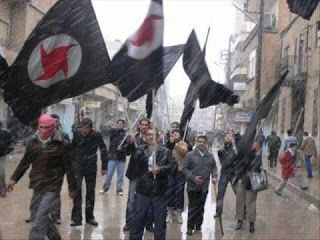
Maqdisi Street just off Hamra in Central Beirut. Historically, this is the heartland and home turf of the Syrian Nationalists. And in fact, it's presence cannot be overlooked. A presence that an unprepared visitor familiar with fascist symbolism might give the creeps. The atmosphere is gloomy albeit Maqdisi being home to myriad bars and stores which is not only due to the multi-storey buildings forming impenetrable walls along the narrow street. Much more it's the countless graffiti, banners and posters depicting the SSNP's red hurricane symbol. According to SSNP it was designed by SSNP students at the American University of Beirut while the party was still outlawed and, supposedly represents a fusion of the Christian cross and the Muslim crescent. With the result being more than just reminiscent of a stylized swastika.

Although the SSNP has always denied beinng inspired or even influenced by European fascist movements, similarities do not end with the outlandish emblem. Quite on the contrary, it would be rather straightforward to argue that the SSNP were a simple offshot. In fact, the SSNP makes abundant use of Nazist symbolism. A very strong leader cult - founder Antun Saadeh is regarded a half-god by most SSNP militants - and the frequently practised Roman salute are only the most ostensible ones. Ideologically it is the expansionist vision of a Greater Syria, stretching frim Cyprus and the Sinai as far as Kuwait and some odd kind of Syrian supremacism, outlined in the party's "Eighth Basic Principle" ("Syria's interest supersedes every other interest") that liken it to European fascist ideas. For an allegedly harmless movement they also have odd friendships, ranging from the German NPD and Italy's Forza Nuova and Casapound which are both nostalgic of Mussolini. In the world of the internet SSNP enjoys the questionable endorsement of "IronMarch", which prides itself on being the "Online HQ for the IronMarch Global Fascist Fraternity and the Forge of the 21st Century Fascist"


Back in Beirut, the wall of buildings seems to be metaphoric for a wall of silence. It is common knowledge in Beirut that Maqdisi street is the home turf of the SSNP and that who wants to plant his seeds there needs to be aware of that. Just ten metres of Hamra Street the SSNP has established its own little kingdom with a firm grip on local entrepreuners that are force to buy water and electricity from SSNP suppliers and are charged $600 per month for "security purposes". The locals know about it and have accepted it, as they have accept the many other inconveniences they have to face in modern Lebanon.

One who didn't know about it, was the British journalist Christopher Hitchens who back in 2009 defaced a "hurricane" in the SSNP heartland and experienced first hand SSNP's fascistic tendency towards violencs:

"Well, call me old-fashioned if you will, but I have always taken the view that swastika symbols exist for one purpose only—to be defaced. Telling my two companions to hold on for a second, I flourish my trusty felt-tip and begin to write some offensive words on the offending poster. I say "begin" because I have barely gotten to the letter k in a well-known transitive verb when I am grabbed by my shirt collar by a venomous little thug, his face glittering with hysterical malice. With his other hand, he is speed-dialing for backup on his cell phone. As always with episodes of violence, things seem to slow down and quicken up at the same time: the eruption of mayhem in broad daylight happening with the speed of lightning yet somehow held in freeze-frame. It becomes evident, as the backup arrives, that this gang wants to take me away."

Hitchens got away. Not all do though. Although relatively unknown, it was the SSNP who pioneered bold and daring suicide missions in the years of Israeli occupation, a method it also used against inner-Lebanese foes. In 1982 they assassinated the Phalangist president-elect Bashir Gemayel, a staunch promoter of Lebanese nationalism, later on they were involved in fierce battle with the Hariris and their Future Movement. Although lacking importance on a political, legislative level (SSNP has only two MPs, one from Baalbeek-Hermel and one from Marjuyun)the SSNP has had and many observers say it still has the power to raise the barometer of tension within Lebanon and, in an explosive situation, might ignite the lit fume.

Where does this power come from? Certainly it is not religion. In fact, it is in fierce opposition to religious institutions, demanding uncompromising secularism and separation between state and religion. Probably because SSNP-style Syrian nationalism is in itself a religion. It is not by chance that new recruits are "baptized", symbolizing the washing away of the past and divorcement from everything that is not in service of the idea. They pledge their soul to the "cause" becoming a uniform collective in service of the party and their leader.

That is the specific danger of the party and the most striking parallel to European-style fascism and Nazi-Germany's regime. Most certainly the centering of the Pan-Syrianist ideology on some virtual superior Syrian ethnicity is a similarity to European fascism. Yet, as founder Antun Saadeh specified in wake of World War II, in contrast to Nazism not focussed specifically on one race, but on one nation, composed by people of several ancestries grown into one big-tent Syrian enthnicity. Albeit still all but liberal or inclusive, the SSNP is more opportunistic than profoundly racist, its goal not being some idea of "purity of race" or world dominion, but dominance over one specific nation, the fertile crescent. It therefore fights against whom they view a menace for this objective, that is Israel and the Jewish People on one side, Turkey and the Gulf States and the militias in Syria that they back.


The alliance the SSNP has forged with Syria's dictator Bashar al-Assad and its still powerful Baathists is therefore even more dangerous. Particularly in the increasingly likely case that Assad will manage to reenforce its grip at least on Western Syria. In such a scenario the SSNP would represent a destabilizing factor in the region, propelling the regime in Damascus to pursue a policy of expansionism. For instance towards Lebanon, where it already is present. Given the limited importance the SSNP bears on a regional level this is still an unlikely scenario. However, it has been proven that in the Syrian civil war the balance of powers can easily shift. And then the Swastika banners may fly not only in Maqdisi Street.